
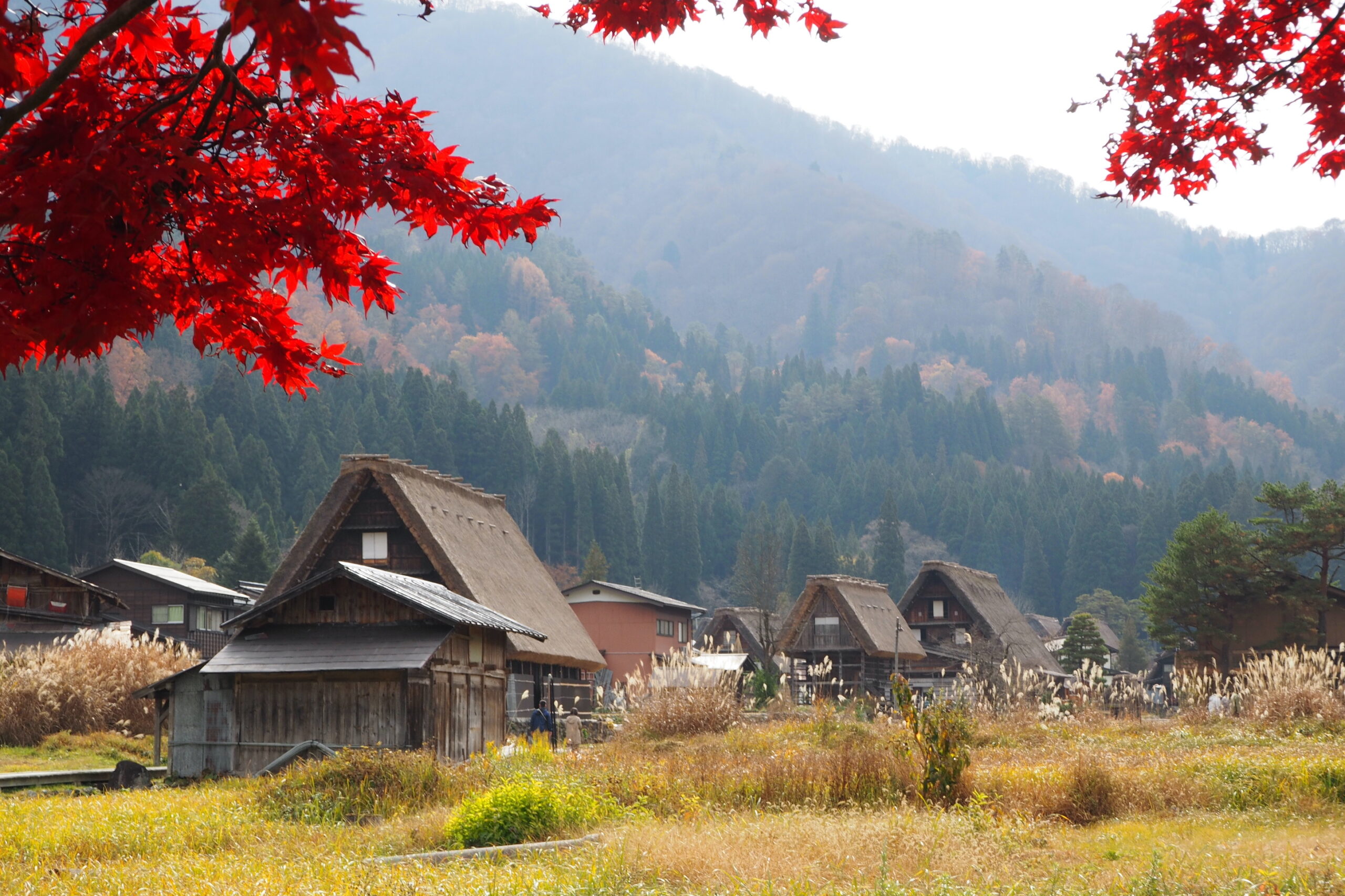
Shirakawa-go’s unique culture is the fruit of geographical isolation and conscious community action
The UNESCO World Heritage Site of Shirakawa-go is nested deep in the mountainous Hida region of Gifu Prefecture, Japan. While it is most visited in winter for its thick snow covered thatched rooftops and signature hotpot dish, suttate, with our November-end timing, I caught myself mesmerized by the fiery autumn foliage all around town. Below are three of the things I learned upon visiting this charming town in Gifu, Japan.

Silk industry induced Shirakawa-go’s architectural style
Shirakawa-go carries the history of millennia. The earliest traces of human activity in Shirakawago, which were pottery artifacts, date back to 7000 B.C. and 2300 B.C., while the first clear mention of „Shirakawa-go” as a village appears in the diary of a Kyoto aristocrat around 1176.
However, the outstanding gassho style of high peak, thatched roofed houses, looking like two hands joined in prayer – thus dubbed gassho by the Japanese -, were first built around 1700. This was in the Edo era, when silk and gunpowder production prospered in town, and the building style advanced from generation to generation, until it reached its present-day form in the 1800s.

Gassho style houses are a perfect fit for Shirakawa-go, being the bearer of heavy snows in winter, and protecting life under. It differs from other traditional Japanese houses in a way that the attics are also employed as spaces of activity. Starting from the Edo period, sericulture was the most important industry for this village, which drove the residents to capitalize on the large attic spaces by turning them into silkworm rearing facilities. Remains of the golden era of silk are still present in the ancient houses scattered all around town, and antique artifacts are exhibited in the Gasshozukuri Minkaen – a splendid outdoor museum of 25 gassho houses.

Living and evolving history
As the official definition outlines, a world heritage site is „A common heritage of humanity that people currently living around the world inherited from the past and must now convey into the future”. Hence, it is the mission and responsibility of Shirakawa-go not only to preserve this village so that it stays intact, but also to attentively pass down the heritage of building technology to the future generations, who will grow its culture further.

The Shirakawa area prides itself in its movement for preservation, which was started upon the unforeseen damages caused by dam constructions and river basin developments in the area. Some of the multiple centuries old houses submerged in water, and many were abandoned or lost to fire. By the dawn of the 1960’s, only 190 of the gassho houses remained.
Shaken up by the destruction of their own culture, in 1971, the villagers’ association agreed not to sell, rent, or demolish any of the houses. Subsequently, locals have been directly involved in the protection of their heritage. The villagers use a collaborative stytem called yui to re-roof the houses. It is a type of labor exchange to assist each other in the heavy chore. A villager who helps out someone is recorded in a book, and is eligible to receive help to re-roof their own house. The re-roofing occasions also serve as an opportunity for the younger generation to learn the traditional methods of roofing, and strengthen the community ties. Walking down the main street, I was excited do spot a few locals working on the public areas and houses.

Wild village with a wild cuisine
Shirakawa-go had been seen as remote and wild, especially when the winter snows cut off communication and transportation to the cities behind its surrounding mountains. Due to the periodic isolation, villagers pivoted to sourcing ingredients from their neighboring abundant natural environment of mountains and rivers, creating a rich local cuisine in Shirakawa-go.
The Hidagyu Suttate hot-pot is the double holder of the Japanese National Hotpot Grand-Prix for an obvious reason. „Suttate” is prepared by adding stone-ground soybeans to a miso and soy-sauce-based soup broth. Then, thinly sliced vegetables follow, with locally sourced cloud ear mushrooms, creating a soft yet crunchy texture. Finally, and most importantly, the hot-pot is completed with slices of Hidagyu beef, the Hida region’s speciality, enhancing the rich taste of the dish. Tasting this hot-pot is a rare opportunity to experience the exclusive flavors of Shirakawa-go.

In addition to Suttate, you can also sample several locally sourced dishes at Shirakawa-go. One of these is udon or soba noodle soup enriched with mountain vegetables. For lunch, I chose Hanamizuki restaurant, which serves matcha soba noodles, matcha tea, and mochi bowls in addition to the very filling udon soups, and has a wonderful view to the neighbouring gassho house.

By visiting Shirakawa-go, I learned that this village is not merely a town of history, but also a representation of a community’s pursuit of passing down knowledge and technologies in the quest for surviving harsh living conditions, which shows best achieved by strengthening the bonds in their community. Turns out, there’s plenty of lessons to be learned from the people of Shirakawa-go.

Information for your visit to Shirakawa-go
I took a bus from Nagoya: it took 3 hours and cost 3,500 yen one way. More information on how to get to Shirakawa-go can be found here: http://ml.shirakawa-go.org/en/access/
Entrance fees are only charged when you enter the houses, and in Gassho-zukuri Minkaen, which consists of 25 houses, you can visit almost all the houses for 600 yen total, where antiques and historical relics are on display. I highly recommend it!
Vélemény, hozzászólás?